 Learning Platform
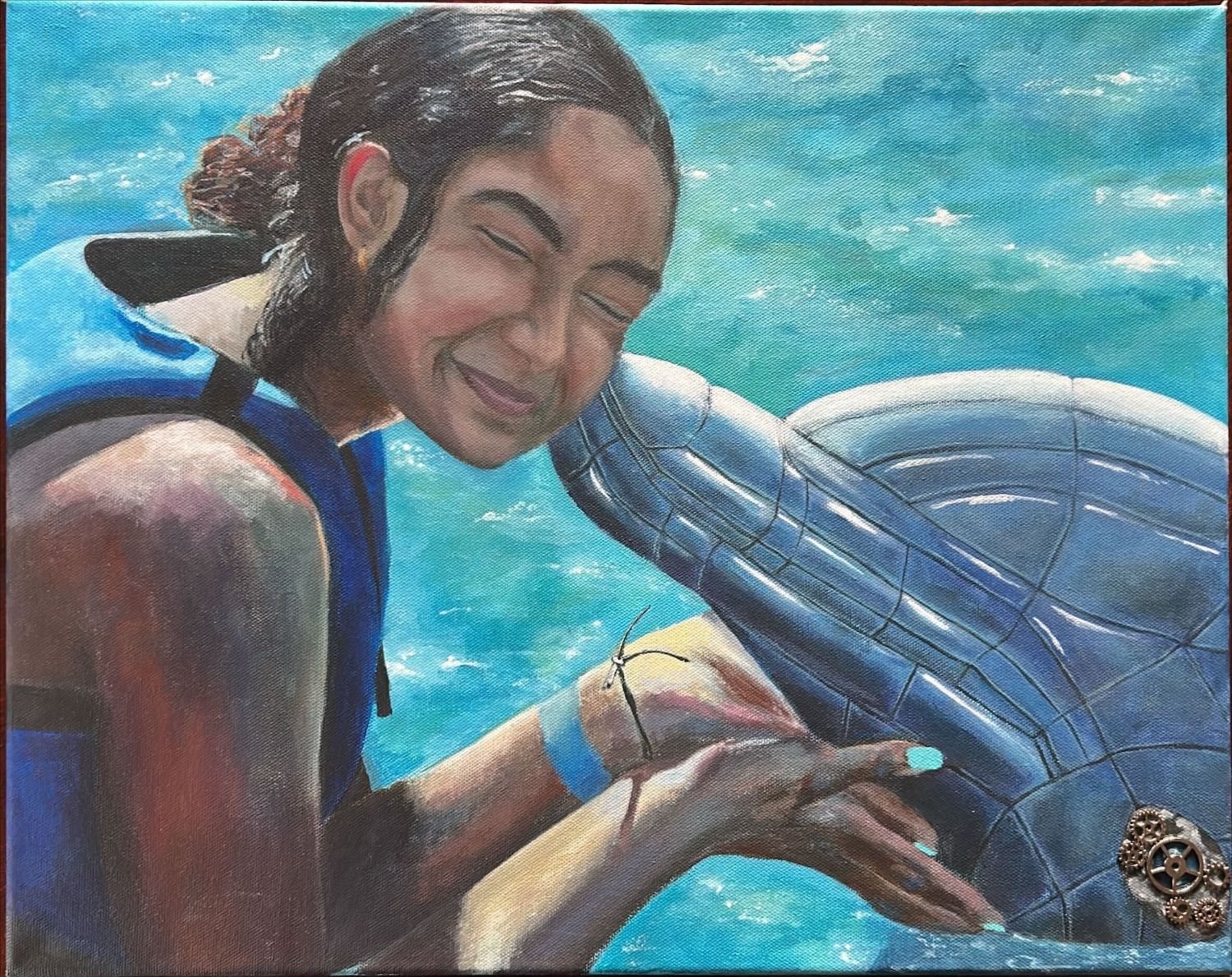 Artwork: Safe Waters
Christopher Newport University
Online Sexual Assault Education Program
RFP 242-27-00013-AS
Overview
A sealed request for proposal from Christopher Newport University for an online sexual assault education program. Proposals are submitted electronically through the Bonfire e-procurement platform.
- 100points available in scoring
- 960–1,200students expected per year
- 1 + 4year term, with four renewals
- WCAG 2.1 AArequired accessibility standard
Video walkthrough
A short walkthrough of the consent module and some of the platform's capabilities, presented by an AI-generated character.
Watch the video walkthrough 2 min 24 sHide the video
The interface shown is illustrative. Phone numbers on screen are examples.
Read the transcript
One in a series of short lessons on consent. From a prevention course for college students. Students sign in with their school account and pick up exactly where they stopped. Every lesson starts by saying what's coming. Students can pause, skip, or stop at any time, and confidential support is listed before the lesson begins. First, the school's own definition of consent. Each school puts its own policy here. Then the plain version: consent is a clear yes, given freely, that can be taken back at any time. Five words to remember. Clear, freely given, ongoing, specific and aware. A yes last week is not a yes today. Asking doesn't have to be awkward. And when someone says "I'm not sure," that means stop and check in.
Can I kiss you? Yes.
Do you want to keep going? I'm not sure. That's okay. Let's just watch the movie. Short checks confirm understanding, and every answer explains why.
Alex and Jordan have hooked up before, but tonight Jordan is quiet and turns away. Choosing to keep going explains why past consent doesn't count tonight. The best choice is simple, stop and ask. A shrug and silence are not a yes. When the answer is unclear, stop and talk.
Help is one click away, on every page, and it doesn't save anything on the device. Consent is a clear yes every time. VersaLearn, powered by Enginuity.
Interactive demo
A hands-on preview of the course, the way a student would see it, is available on request.
The need
Federal law, through Title IX and the Violence Against Women Act (VAWA), requires colleges to educate new students about sexual harassment, sexual assault, dating violence, domestic violence and stalking. Christopher Newport University, a public university in Newport News, Virginia with about 5,000 students, issued this RFP to find a ready-made, cloud-based program to deliver that education.
CNU also wanted the program to do more than teach. It asked for data the university can use to understand its students' experience and campus climate, including trends over time and comparisons with peer institutions. The contract is written so other Virginia colleges and public bodies could buy from it too.
Contract basics
- Initial contract period of April 20, 2027 through April 19, 2028
- Four optional one-year renewals
- Electronic submission through the Bonfire e-procurement platform
- Commodity codes 92400, 92506, 92416, 92418 and 95271
How proposals were scored
Price is scored by formula: the lowest price offered, divided by the price being evaluated, multiplied by 15 points.
What stood out
- 75 of the 100 points reward the substance of the program: the quality of the education, VAWA compliance and fit to CNU. Price counts for 15.
- Compliance is weighted as heavily as the education itself (25 points each), so a platform has to show it meets the law, not only that it teaches well.
- Personalization is worth 25 points, so a generic course loses ground. CNU's own policies, honor code and campus resources have to be built in.
Requirements in detail
Summarized from the solicitation. Open each group to read it.
Required education content (Title IX and VAWA)9
- A statement prohibiting sexual harassment, sexual assault, dating violence, domestic violence and stalking on campus
- Definitions of each of those terms under Title IX
- A definition of consent, tied to the institution's own policy
- Safe bystander intervention options, with examples
- Information on risk reduction
- Warning signs of abusive relationships
- Reporting procedures, rights, confidentiality, formal complaint steps and campus resources
- Who at the institution receives reports under Title IX
- Ongoing prevention and awareness campaigns
Additional content CNU required3
- The impact of alcohol on sexual assault and consent
- Applicable federal and state laws
- Sexual exploitation, and non-physical dating or domestic violence
Learner experience8
- Web-based, usable on any computer, tablet or phone
- Unlimited logins so the whole campus can use it
- Self-paced: pause, save and resume at any time with no loss of progress or scoring penalty
- Clear content advisories, and lesson outlines students can review before sensitive topics
- A certificate or notice of completion
- CNU's policies, honor code and resources built into the program
- Relevant to 18–22 year olds, with modules suited to adult, remote and graduate learners
- Content updated every year, with notice of changes
Data and reporting6
- Live completion tracking
- Reports at the individual and institutional level
- Analysis of the assessments used within each program
- Awareness, perception and climate trends for CNU
- Comparison with peer institutions and national data, year over year
- Evidence that the program has produced educational results
Accessibility6
- Meets Section 508 and WCAG 2.1 Level AA, documented with a VPAT
- A demo or development environment so CNU staff can test accessibility themselves
- Fully keyboard navigable with no traps and clear focus indicators
- Synchronized captions and verbatim transcripts for all video and audio
- Audio description for visual content that is essential to understanding
- Text that scales to 200% without breaking, plus high-contrast options
Security, reliability and support7
- Sign-in integration with Microsoft Entra ID
- A SOC 2 Type II report or an equivalent such as HECVAT, renewed every year
- Log export to security tools such as Microsoft Sentinel or Splunk
- Stated uptime, outage notice, backups and data recovery timelines
- A no-cost export of all CNU data when the contract ends
- The vendor's own technical and customer support
- A data protection addendum (Attachment H)
Implementation4
- A plan with timeline, milestones, roles and a governance model
- How existing data on the current platform will be kept
- Training plans and documentation
- Support resources for administrators and for other users
Other interests (optional)3
- Refresher training for continuing students and for employees
- Education for new employees
- Modules on alcohol use and on college student mental health and wellness
How the process works
- QuestionsWritten questions only, through the Bonfire platform, due October 29, 2026 at 12:00 p.m. Eastern.
- ProposalDue November 19, 2026 at 2:00 p.m. Eastern, submitted only through Bonfire as two PDFs: a full signed copy and a redacted copy with proprietary material removed.
- Required documentsAttachments A–H: pricing schedule, conflict of interest statement, vendor data sheet with at least three client references, State Corporation Commission form, small business subcontracting plan, proprietary information form, contractor background certification and data protection addendum.
- DemonstrationOfferors who submit must demonstrate their solution to CNU. Oral presentations may also be requested.
- Evaluation and negotiationCNU scores proposals on the 100-point scale, selects two or more offerors to negotiate with, then awards the contract to the offeror with the best proposal.
- No contact ruleWhile the solicitation is open, offerors may not contact evaluators or other university staff. Questions go to the named buyer.
Timeline
- RFP issuedOctober 12, 2026
- Questions dueOctober 29, 2026, 12:00 p.m.
- Proposals dueNovember 19, 2026, 2:00 p.m.
- Contract period beginsApril 20, 2027
My response
This solicitation is still open, so the response itself is not shown here. What I can share is what I took from reading it, below, and where I am taking the platform next.
Next steps
I'm building a sexual assault prevention education platform that any Title IX office in the United States can run on its own terms. The next step is to put it in front of the universities that need it.
- One platform, every campusEach university gets a program that fits its own campus and its own policies.
- The Title IX office stays in chargeThe office decides what its students see and how the program is run.
- Bring it to other universitiesI will share the platform with Title IX offices and procurement teams at other universities across the country.
Outcome & reflection
What this RFP taught me about building a course versus meeting a compliance standard
I used to think the hard part was making a good course. This RFP changed that. A university has to prove it meets the law, and that proof counts for as many points as the teaching itself. A platform is not finished when the lessons are done. It is finished when a Title IX office can show anyone who asks what its students learned and that they finished it. Teaching well and being able to prove it are two different jobs, and a school needs both.
What I would do next
Keep studying real solicitations, and keep asking the people who run these programs what they need. Then test every idea against what a campus actually requires, not what is easiest for me to build. The goal is a platform that any Title IX office can trust, run on its own terms, and afford.